

The Town of Truro is taking proactive steps to safeguard Victoria Park’s hemlock trees from the threat of the invasive Hemlock Woolly Adelgid (HWA). Though HWA has not yet been detected in the park, experts believe its arrival is imminent, and early intervention is critical.
To protect the health of Victoria Park’s forest ecosystem, the Town is implementing a strategy that includes:
-
Increased monitoring and surveys
-
A chemical treatment program to protect at-risk trees
-
Plans to introduce biological controls as a long-term management solution
pdf Read our Hemlock Woolly Adelgid FAQS (199 KB)
Hemlock Conservation Program
The Town of Truro launched its Hemlock Conservation Program in June 2025 to help protect Victoria Park’s old-growth forest from the invasive Hemlock Woolly Adelgid (HWA).
As part of this work, select areas of the park will be treated to protect vulnerable trees. Treatment zones will be clearly marked with signs and barriers. To help ensure a smooth and safe treatment process, please avoid these areas on treatment days. Once signs and barriers are removed, the areas will be safe to access again. We appreciate your cooperation in keeping both visitors and work crews safe.
Spring 2026 Treatment Schedule
- April 7th-10th- Stand #2587 Victoria Park-Lower Parking lot closed on treatment day- Do Not Enter-Signage and Barricades posted for 24 hours after treatment.
- April 13th-17th Stand #2587 Behind Lower Park Maintenance shed/Picnic Pavillion
- April 27th-May 1st Stand #2582 Flemming Road/Hemlock Trail – Treatment Scheduled
- May 4th – May 8th Stand #2582 Flemming Road/ Hemlock Trail – Treatment Scheduled
- May 11th – May 15th Stand #2582 Flemming Road/Hemlock Trail – Treatment Scheduled
- May 18th- May 22 Stand #2593 Serpentine Trail
- May 25th- May 29th Stand # 2593 Serpentine Trail
June Treatment Schedule to be determined.
pdf Map of Treatment Locations(3.17 MB)
Why This Matters
Eastern hemlocks are vital to Nova Scotia’s old-growth forests. They provide shade, stabilize soil, and support biodiversity. In Victoria Park alone, approximately 12,000 hemlocks form ten distinct stands below Lepper Brook Dam, playing a crucial role in maintaining the park’s natural balance and beauty.
What Is Hemlock Woolly Adelgid?
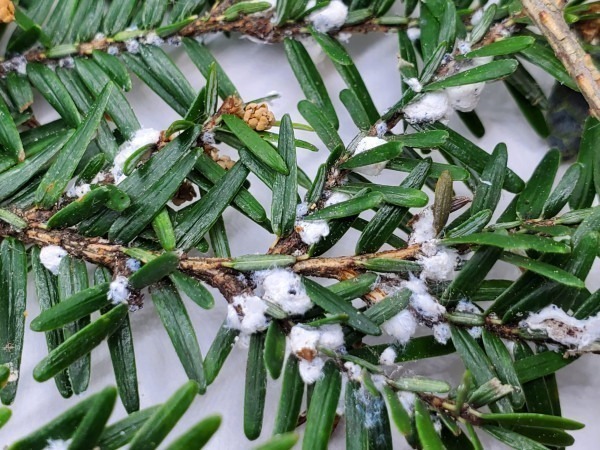
HWA is a small, aphid-like insect that feeds on the sap of hemlock trees. Over time, this feeding weakens the trees, leading to their decline and eventual death. First discovered in Nova Scotia in 2017, HWA has now been found in at least seven counties in the southwestern part of the province.
How You Can Help
Residents and visitors can help reduce the risk of HWA spreading to Victoria Park:
-
Avoid infested areas, especially between April and July, when HWA is most active.
-
Do not move firewood, branches, or outdoor gear between forests.
-
Wear clean clothing and wash it after visiting potentially infested areas.
-
Avoid parking near or under hemlock trees.
-
Place bird feeders away from hemlock trees to help limit spread.
Report Suspected HWA Sightings
If you believe you have spotted signs of HWA, please contact the Park, Recreation and Culture Department at:
902-893-6078
